YayBlogger.com
BLOGGER TEMPLATES

Thursday, 21 April 2016

HUMAN RIGHTS

In this post about human rights, I'll seek the answer for four questions that we don't usually ask ourselves, but are quite important when it comes to understanding how society works (or should work). Let's get right into it.

1. What are human rights?

Probably, the most popular answer would be: the rights we have just for being human. It's not a bad answer but, more precisely, human rights are a series of freedoms and rights that must be guaranteed for every human in order to ensure the respect we all deserve (and also want out of empathy).

2. When and why were they created?

Throughout history, there has been many attempts to create a list of human rights, but the one that has lasted until now and is accepted around the world is the Universal Declaration of  Human Rights. It was created in 1945, after the Second World War, by the United Nations (in New York). The list was created to ensure that a chatastrophe like the recent war and other ways of injustice wouldn't ever repeat.

3. How many human rights are there?

There are a total of 30 human rights.

4. Which human right were you not familiar with?

To answer this question, I'll further explain one of the thirty human rights that you can find listed here. In particular, I will talk about Article 4. Here you can see what it is about:

Article 4.

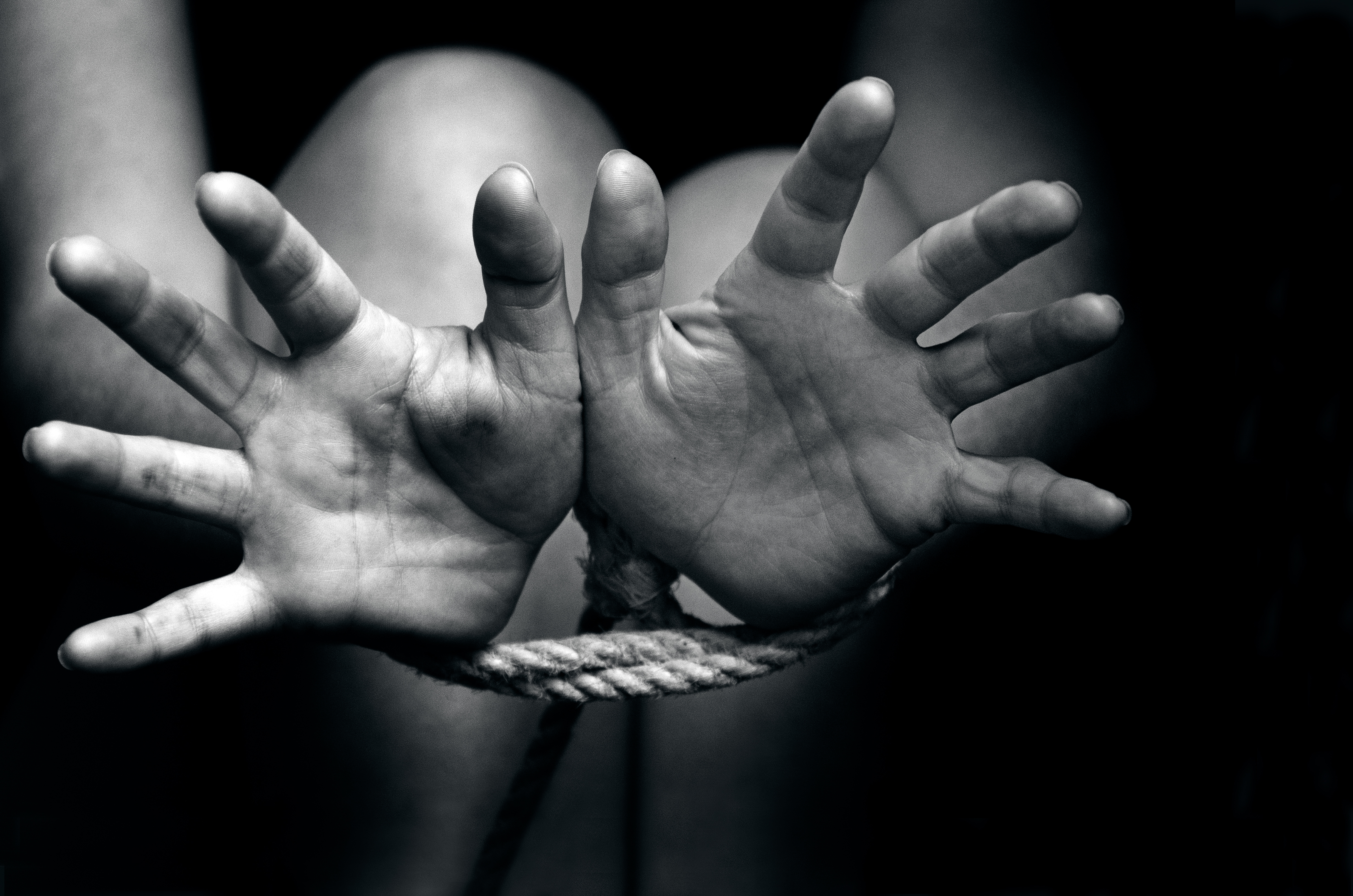
No one shall be held in slavery or servitude; slavery and the slave trade shall be prohibited in all their forms.

Now, according to the question that I intend to answer, of course I knew that freedom of slavery was a human right, and that slavery is forbidden in every way. I also knew that, sadly, there still slaves today. What surprised me greatly was the fact that, nowadays, there are more slaves than ever. More than 27 million. Around 30 million slaves. My first thought when I heard about this in this video was: How can this be possible? How did we not realize? And worse than that: Do we know about this but do nothing against it? 

According to this article, here's a map that shows where most slaves in the world live:


We can see that the countries that are more affected by slavery are in Africa and Asia (India is one example). On the other hand, the less affected would be the United States and European countries.

Slavery is illegal all around the world, but the right of freedom is still violated everywhere. Nowadays, slaves are forced to endure slavery by descent, bonded labor, forced migrant labor, sex slavery, early or forced marriage, child labor... And, sadly, many more. There are many ways in which these slaves are exploited, and this has to come to an end.


But why is this possible? How can we allow this scourge of society to go on? Just in the United States, "the land of the free", there are 60,000 slaves today. It seems like we are turning our backs on them and we shouldn't do it. We all have rights, and if we don't fight against this oppresion we lack of respect for humanity itself. Even if we aren't living slavery in the flesh, we still can't act as if it's not a real problem. I think that the governtments should do more in order to crack down slavery, to stand up for human rights and equality.


Here you have a video from Youth for Human Rights that I think is quite touching and that sends a clear message to society, which seems to be blindfolded.


Sunday, 13 March 2016

Hail, Caesar! Review

Hail, Caesar! is the last production of the Coen brothers, starring Josh Brolin,George Clooney, Scarlett Johanson, Ralph Fiennes, Alden Ehrenreich, Tilda Swinton, Channing Tatum, Jonah Hill and more. It's a comedy that follows the kidnapping of Baird Whitlock, an actor in the 1950's, and how Eddie Mannix, a Hollywood fixer for Capitol Records, has to deal with the problem before the news reach to the media while keeping all the actors of all the productions in line. It's a fantastic comedy that clearly has the name of the Coen brothers stamped on it. If you like their humor, chances are this can be a good film to watch for you!


Eddie Mannix works for Capitol Records in the 50's, in the heart of Hollywood. His work consists on having everything under control in all the productions. In particular, he keeps an eye on actors and directors, having to deal with their problems himself so the show can go on. Baird Whitlock, a well-known actor, is starring as the main character in the companies' latest production: Hail, Caesar! But, as a result of a hidden conspiracy, he is kidnapped and taken away. Eddie Mannix has to find a way to solve this problem before anyone else realises that the actor has gone, indeed, missing.

George Clooney as Baird Whitlock


Personally, I really enjoyed the humor in this film. However, I understand that it's not the kind of humor that everyone likes. The story was simple but well developed, with some twists here and there. The characters were outstanding on their own, specially Eddie Mannix played by Josh Brolin and Hobie Doyle played by Alden Ehrenreich, in my opinion. The performances were all great and made the film funnier and with a good final result. I had seen George Clooney in another Coen's film, Burn after reading, and I was glad that they chose him again for this film (just the faces he makes are priceless). I also liked the way 50's Hollywood was shown in the movie. You could see all the sets and the little problems between the actors and the directors. This is why I found Eddie Mannix's character so interesting: he was the man in the shadows that everyone knew and trusted with their problems. On the other hand, my favourite performance was Alden Ehrenreich's Hobie Doyle, he was by far the funniest character and he did a great job portraying it.

Here's Alden Ehrenreich and Ralph Fiennes as Hobie Doyle and Laurence Laurentz.
In my opinion, one of the funniest scenes.


One thing I didn't like about the film is that the story could've been more developed. It had more potential, in my opinion, that it was given. It was still a good story, it's just that I expected something more. Anyways, I enjoyed it and laughed a lot.


As a conclusion, if you like comedies with silly characters and plot complications that no one had thought about, then this film is for you. All I can say is that the Coen brother's films never fail to surprise me, and this has been no different!

Here's the trailer!


It will only cost your privacy

In 140 characters people can share their opinion on anything they want thanks to Twitter. They can share their life, what they are doing, who they are with, who's their friend and who isn't... There are many social networks through which we can express ourselves.

However, what happens when all your life is exposed? When everyone feels free to give their thoughts about you away on the Internet? Imagine they're interested in you, they want to know everything and even more about your life, they make speculations on your actions and analize your every move. It would be extremely bothering, right? Well, at least that's how I see it. Regardless of how unfamiliar this may seem to most of us, that's what fame is about nowadays.


More than ever, famous people are followed and stalked not only by paparazzi, but also by their fans. More over, the total freedom of the Internet and social networks creates a bigger exposure to every kind of opinion, both good and bad. From the safety of our their homes, some people feel untouchable and powerful on the Internet and they forget one thing that is baseic to every human being: respect. In my opinion, the fact that someone is on the spotlight and their life may be the centre of the public eye doesn't give us the right to disrespect them whether it's stalking them lika a crazed fanatic (I'm talking about extreme cases, of course) or criticizing their person and actions without taking into account how bad it must feel. After all we are all humans, we're the same, and that means famous people can be as hurt by unnecessary hate as anyone else. That is wrong and not only if it happens to famous people but everybody.


Of course, on the other hand, social networks have become a major boost to a lot of celebrities. They can be closer to their fans and have more interaction with them.

As a conclusion, I think that social networks are helpful for famous people to connect with their fans, but they're also a great source of problems. Too many people take the Internet as a lawless territory where anything is allowed but, as humans, I think that we shouldn't forget to respect one another so easily.

Here's a video of Jimmy Kimmel's TV talk show that I think sums it up!


Russian Man May Face Prison For Saying 'There Is No God'

This piece of news was written by Alexandra Ma for the Huffington Post online newspaper on the 3rd March of 2016.

The news is about Viktor Krasnov, a Russian man who is facing a trial that may result in one year of prison, or a 300,000 rubles fine, for saying that "There is No God" on a social network called VKontakte. He also said that the Bible was a bunch of Jewish fairytales and mispelled "God". Article 148 from 2013 (according to the article, it "criminalizes acts that insult people's religious feelings and beliefs") is the law that condemns Viktor's actions.


He is not the first one to be criminalized by this law. Two members of the band Pussy Riot faced two years of prison for making a song where Virgin Mary told Putin to go away. The trial caused a worldwide outrage.


The online discussion was between Viktor Krasnov, Dmitry Buryashev and Alexander Kravtsov. Krasnov used his comments to stand up for sexist comments from the other two. Burnyashev and Kravtsov reported him to the police. Krasnov and his family started to receive threats from Orthodox Christians (his mother almost lost her job), but the police didn't want to do anything about it. Although the discussion is still active on VKontakte, Krasnov's comments have been deleted.

According to the article, though there's is no official religion in Russia, around 70 per cent of the population is Orthodox Christian.


In my opinion, this is very deplorable. Not Krasnov's actions, but the Russian court's. Nowadays, people are free to speak their minds online, and there is nothing that can change so much from one person to another than religious feelings. You can be an extreme Orthodox Christian, a jew, an atheist... It doesn't matter. Your feelings are yours, no one's taking that away from you. But to harm others and condemn them claiming to "defend" your religion? That is not how it works. And what is even more shameful is that the Russian "justice" is criminalizing this. What about the sexist comments from Burnyashev and Kravtsov? Do those not matter? Are those not punishable? Well, in this case, they should take a closer look at that as well.

VOCABULARY

prosecuted: to begin or conduct legal proceedings against (a person), as with a criminal charge in a court of law.

fine: money imposed as a penalty for an offense.

amid: in the middle of.

Joy as twin boys joined at the stomach are successfully separated by surgeons using a 3D PRINTER

This piece of news was written by Kate Pickles for Mailonline, from the Daily Mail online newspaper, on the 7th March of 2016.

The news is about two conjoined twins from China that have been successfully separated thanks to a 3D printer. Their names are Yu Ce Yuan and Yu Ce Xiang, and their abdomens were conjoined at birth. After sending in accurate data from the babies medical and physical conditions to a 3d printing company, they could create replacements for the conjoined parts of the twins' bodies and, in that way, they ensured their survival.


This, however, was possible after a 12-hour operation at Children's Hospital of Fudan University (Shanghai). The hospital had only faced nine cases of conjoined twins and, according to Dr. Zhen Shang, this was by far the most difficult one. Nevertheless, life would've been imposible or a nightmare for these children if they hadn't gone through the operation. The operation consisted in separating their liver and pelvic bone after reconstructing the cavities with the 3d printed pieces. Even though both babies are doing fine, doctors say they'll need futher operations.

The parents received help from donations from around the world thanks to Love Without Boundaries (a charity)that paid for the medical taxes and for the operation fee.


Yu Ce Yuan and Yu Ce Xiang before the operation


After the operation


In my opinion this is great news. The applications of 3D printers amaze me. This is not the only medical advance that has been posible thanks to this kind of technology, but also many more. Also, I've seen some work in architecture using 3D printers! Although I think they should be a little bit controlled (can you create a gun that works? Better be careful with that), I believe that this invention is, and will keep being, something that will help us in a lot of different areas. Also, once again, this demonstrates that technology can make a better world, if we know how to use it.

VOCABULARY

conjoined twins: two babies born joined together at some point, such as the hips. Some have lived for many years without being surgically separated.

bladder: a hollow organ in the body that is shaped like a bag and may hold gases or liquids, esp. urine.

discharge: to release or send away.

Saturday, 12 March 2016

Art or crime?

Take a look at this picture:

by Borondo, in India

What about this one?


I'm sure you've seen a lot of these as well:


We all know graffiti, but is it art or crime?

Some people say that graffitis damage the visual impression of the buildings in which they're painted. It is considered a crime because it modifies private (or public) walls without any permission (not all of them, though).

On the other hand, there are people who think that graffitis are another way of art. This is actually what I think, and now I'll try to explain why.

For me, graffitis can revitalize the city (or anywhere really) with art, using new shape and color. As any kind of art, it's a way of expression that can give many different stories to the boring walls that we see everyday. Graffiti is not only a diversion for some people, it is also used as a way to vindicate and call society out.

An example of this vindicative art is the work of Banksy, an artist that has become famous around the world for his urban art pieces with deep and meaningful meaning against society. Here I'll show you some examples:


He has made a huge impression with these paintings around the world, and has won recognition as the artist he is. Last year he was able to open an art project by the name of Dismaland, located in Sommerset and mocking the amusement park of Disneyland, though it is anything but amusing. He wanted to do the same that he does with his art: open your eyes to how our society is.

Additionally, a lot of graffitis are stunningly beautiful and some of them could be considered masterpieces. One way or another, it's art, just like any painting that you'll see in a gallery for an insane fee. This kind of art is totally free. It's made by the people and for the people, with a wish to express.

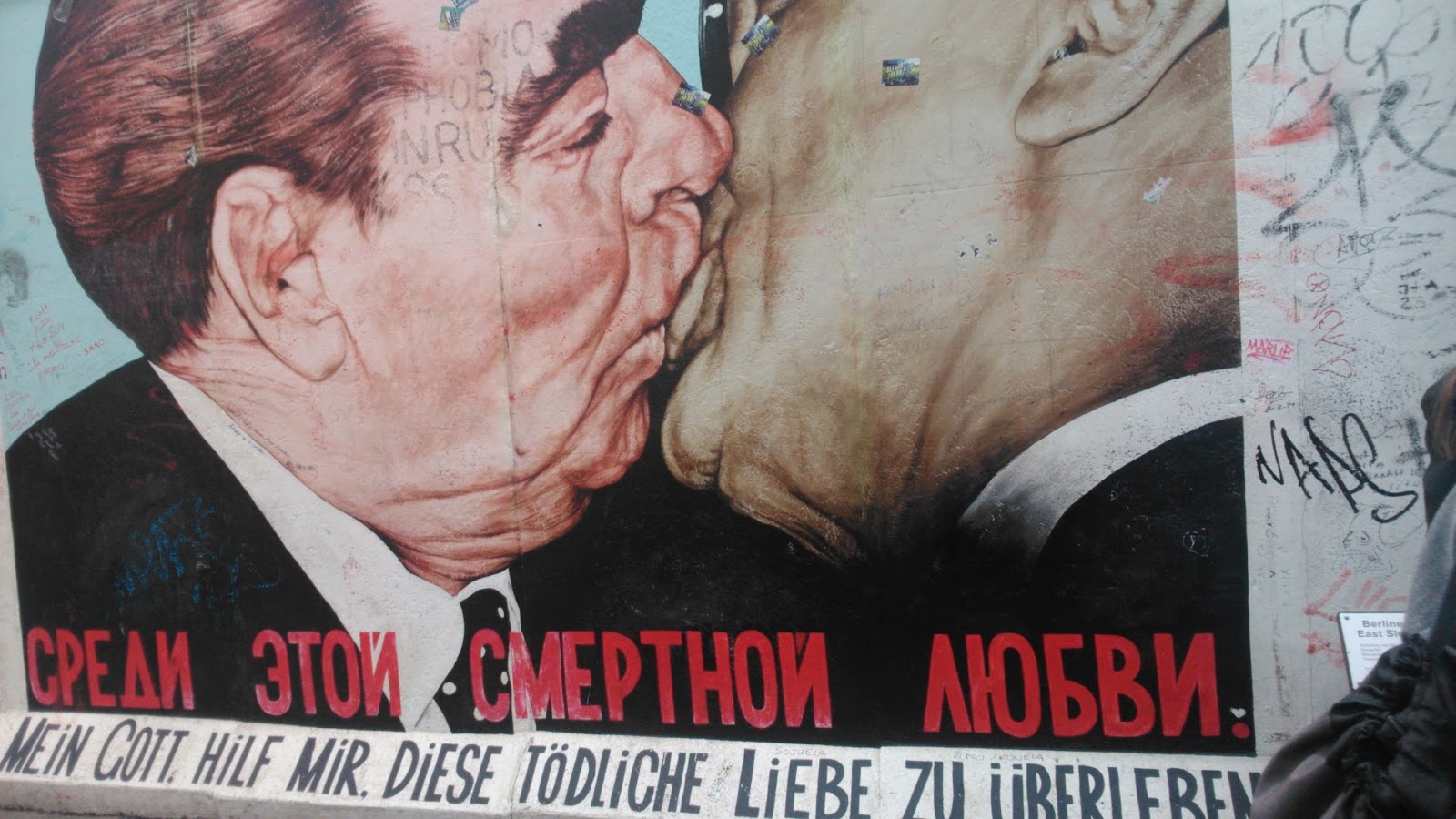
One thing that really impressed me about graffitis was the remainings of the Berlin Wall. During our 4th ESO trip, we visited the monument and it was all decorated with artsy graffitis  that I loved. Here I have some of the pictures I took:


Well, I know that these are not the typical type of graffiti. On the other hand, I know that many street art pieces have a lot of street and very little bit of art. But just the fact that some artists aren't really good doesn't mean that graffitis should be banned! That would be like saying that no one should have been able to paint if their art didn't look like Leonardo's, Van Gogh's or Turner's.

So if you are an artist in need of inspiration remember that the street can also be your canvas!

How you can erase painful memories just by moving your eyes

This piece of news was written by Alice Smellie for the Daily Mail online newspaper on the 6th March of 2016.

The news is about Eye Movement Desensitization and Reprocessing (EMDR), a successful therapy that has proven to be effective in cases of anxiety, Post Traumatic Stress Disorder (PTSD), depression, stress and more. The method consists in moving your right hand back and forth in front of the patient's eyes between 25 and 30 times in intervals in long sessions (up to one hour in some therapies). EMDR is used to eliminate bad memories that we have and, by doing so, increase our wellbeing. It was first developed by psychologist Francine Saphiro.

According to Dr. Robin Logie (EMDR Association in UK and Ireland), the reason why we remember bad memories more than anything else is that our brains can't process them. Memories go through a mental process that allows us to assimilate them and gain experience and knowleadge from them. It doesn't work the same with bad memories: the brain is unable to assimilate. In addition, the sensorial part of the brain (sounds, smell, vision...) is the active one instead of the rational part when we recall this kind of memories, so the sensation we get is more vivid and not objective at all. This can make us feel really bad, both physically and emotionally. In the article, Saphiro even stated that there are between 10 and 20 memories stored in our brains that cause most of the pain in our lives.


The method has proven to be successful in many cases and it's training is now compulsory for the Ministry of Defence mental health personnel. However, Dr. Logie warns that you should put yourself in the hands of a specialist.

The method doesn't erase the memory completely. What it does is that it diminishes the emotional charge it has so the brain can reprocess it and, as the article says, "put it in the right place". In this way the memory is still there, but it doesn't cause us any bad emotions.


There are two theories on why this works. The first one says that it's like the REM fase of our sleep, in which we aren't able to focus on emotions because of our eye movement and can only process situations. The other says that our brains are less focused on emotions when distracted with something to do, with a work to do.

In my opinion this is a very interesting method. I think that a bad memory can haunt you forever, and for you to be able to calm yourself down and get rid off that bad feelings it causes you is a great thing and definetly an improving in wellbeing. I hadn't heard about this therapy before, but it seems like a helpful method that can be used in a lot of areas, such as PTSD. I'm very glad to know that such therapies (that don't involve pills or anything like that) are helping so much in nowadays society to make our lives a little bit easier.

Here's the news' video!


VOCABULARY

desensitize: to lessen the sensitivity of something.

pathway: a path, course, route or way.

ludicrous: causing or deserving laughter because of being absurd; ridiculous; laughable.